
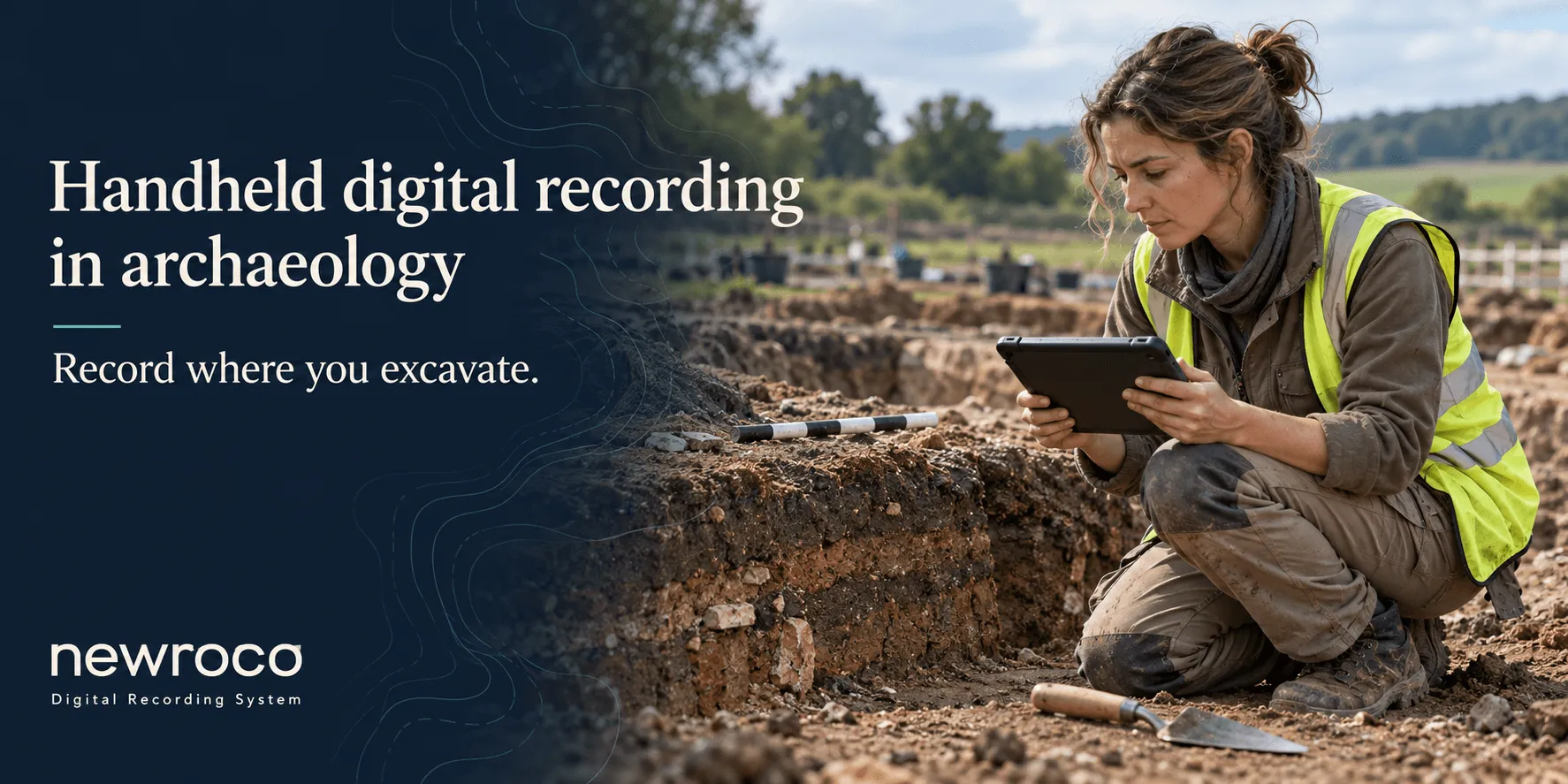
Record where you excavate to save time and improve efficiency
Today, an archaeologist is recording a deposit beside a trench. The evidence is still there: its boundaries, composition, and relationship to neighboring contexts. Now is the right time to document the moment carefully.
With the right technology, archaeologists perform their work better and more efficiently. When data is recorded properly, research progresses smoothly. On site, archaeologists need greater flexibility to record data faster.
Handheld digital recording in archaeology
This is where handheld digital recording comes in handy. With this type of technology, those observations can enter a structured record directly on a tablet or smartphone. Archaeologists use such devices in order to record findings faster and with additional information. With greater liberty on site, it becomes easier for researchers to cover more ground.
The project evolves faster with less friction and fewer errors on site. Everyone wins: the archaeologists on site and the researchers waiting for new data on the project’s evolution and findings.
As an archaeologist, you stay close to the findings, while the data starts its journey to the project database without an extra paper-to-digital transcription step. Less time wasted, and more allocated to other priorities. This is one of the major problems indicated by the archaeologists we work with over the years.
For all field teams, that flexibility is essential. They need recording tools that fit the work location, the available Internet connections, and the way archaeological work starts and develops every single day. As you probably know by now, things change on site, and archaeologists need to adapt fast without negative impact on their work.
Digital Recording System by Newroco
Our Digital Recording System (DRS), developed for Oxford Archaeology, puts handheld field recording at the heart of archaeological work. Swifter results, smooth workflow.
What is handheld digital recording in archaeology?
Handheld digital recording in archaeology is perfect for the capture of field observations directly into digital forms on portable devices, such as tablets and smartphones. An offline-capable system allows recording without a continuous internet connection and synchronises records with a central system when connectivity is available.
The objective is to keep documentation close to the work and reduce unnecessary transfers between recording formats, which allow the appearance of errors. You eliminate human error from the archaeological workflow.
Digital Recording System is a private progressive web application developed for Oxford Archaeology to record on-site data using handheld devices. The technology adapts easily to the specific needs of archaeologists. Its project description identifies the removal of paper-to-database copying as the main advantage for archaeologists who want to remove unwanted paperwork.
Why does flexibility matter during archaeological fieldwork?
Recording rarely happens in an office with all the stability it entails. All team members of an archaeological project move between areas, inspect characteristics, and revisit descriptions as an excavation develops. Connectivity may be short-handed at times, and the device available to one person may differ from the device used by another.
A flexible recording workflow accommodates changing work conditions. Archaeologists need a practical way to capture observations at the point of work and preserve them for subsequent manual review.
There are three useful dimensions to this flexibility:
LOCATION: recording can happen alongside the evidence.
CONNECTIVITY: data entry can continue during interruptions in internet access.
WORKFLOW: forms and recording structures are configured around project needs.
Together, the three capabilities help reduce the distance between making an observation and creating a usable project record.
1. Record observations while the evidence is in front of you
Handheld devices allow you to enter a description while examining the context itself. An archaeologist can check a detail against the visible deposit rather than reconstructing it later from different notes.
This particularity can support careful documentation. It does not guarantee that every interpretation is correct, but it creates a useful opportunity to check observations while the evidence remains available.
BENEFIT: a recording process that fits around excavation, with fewer intermediate steps between observation and documentation.
2. Continue recording even when internet connection is unavailable
An online-only form depends on an Internet connection at the moment of entry. An offline-capable recording system allows data capture to continue when that connection is missing.
Digital Recording System was designed for archaeological sites with fluctuating Internet connectivity. The application requires an internet connection to load initially. After that, it supports offline data entry and communicates with the server to send or receive new data.
This difference is relevant when preparing devices before fieldwork. Teams need to load and prepare the application while connected, then follow their agreed synchronization procedures on site. That is all. The rest runs as planned.
Offline recording and shared availability are separate stages: an entry held on a disconnected device becomes available centrally after successful synchronization.
3. Reduce duplicate data entry
You know the process can render errors. Where paper records must later be entered into a database, the same information passes through two recording stages. Someone writes the observations, and someone types them again.
What changes? Direct digital entry removes the transcription step for the records managed within the system. The value extends beyond the typing itself: unclear handwriting may need clarification, and copied entries require checks against their originals.
4. Support consistent records while allowing project-specific detail
The majority of archaeological recording needs structure and room for attentive description. Identifiers and terminology need to be stable, while observations and interpretations may require details.
You have access to customizable forms and validation rules. These can support the recording requirements agreed for an implementation.
In a well-designed workflow, checks might flag a missing required value or an entry that needs attention. These are examples of checks to discuss during configuration, rather than a claim that every project uses identical rules.
While software checks aspects of a record’s structure, archaeologists remain responsible for the observations and interpretations it contains.
5. Make the transition from fieldwork to review more straightforward
Field records are useful when the colleagues reviewing them can access a coherent dataset.
Following synchronization, digital entries can move into the project’s review process without first being retyped from paper.
As a practical consequence of that workflow, a supervisor may be able to identify an incomplete description while the field team still has an opportunity to revisit the feature.
A successful digital recording involves people as well as software. Teams need to agree who checks records, when review happens and how questions return to the recorder.
How Newroco’s Digital Recording System supports handheld work
Our system brings together on-site digital entry, offline functionality, and synchronization. The system fully supports handheld devices and adapts to different screen sizes.
The application is a progressive web app: a web-based application designed to provide app-like functionality, including the offline recording behaviour implemented in this project.
What should teams consider before adopting handheld recording?
You could start with a realistic field trial. Ask archaeologists to complete representative records and review the results with the people who use that information later.
Things to assess:
Device suitability: screen readability, handling, protection and battery capacity.
Offline preparation: what needs loading before leaving a connected environment.
Form design: navigation, typing effort and space for detailed observations.
Data checks: which fields require validation and which decisions require expert review.
Synchronization: how users confirm that records have reached the central system.
Data management: review responsibilities, exports, and documentation and backup arrangements.
Locally stored, unsynchronized records need protection. An offline workflow should include clear procedures for device care and regular synchronization.
Frequently asked questions
Can archaeologists record data on tablets and smartphones?
Yes! Digital Recording System supports handheld field recording, with accent on tablets and smartphones. The appropriate device depends on the forms, site conditions, and practical requirements of the archaeological team.
Does the digital system work without an internet connection?
Yes, after the application has first been loaded with an internet connection. It supports offline entry and communicates with the server when connectivity is available for data transfer.
Does handheld recording remove the need for transcription?
Direct digital entry can remove paper-to-database transcription for records captured within the system. Data still needs quality review and any processing required by the project.
Can the recording forms be customized?
Yes. You have access to customizable DRS forms. The fields, terminology and checks are easy to introduce within new frameworks.
Does digital recording replace archaeological judgement?
No! Archaeologists still observe, describe, assess relationships and interpret evidence. Software supports the organisation and transfer of those records.
With our help, you can build a recording workflow around your team’s needs
The value of handheld digital recording is practicality. Capture observations close to the evidence, continue recording through connectivity interruptions, and transfer records for review without unnecessary re-entry.
Are you looking for a digital recording workflow that fits your archaeological projects?
Contact Newroco to discuss your field project! There are solutions to any problem. We can help you with them!