

We have a beginner’s guide to the programming language that powers the modern world
“Code is read much more often than it is written.” — Guido van Rossum, creator of Python
Python is without a doubt one of the world’s most influential programming languages. You can find Python in artificial intelligence, data science, websites, video games, and applications.
Programmers feel it natural and easy to apply to different circumstances. If you start looking for Python presence in everyday apps and digital services, you can find it in Instagram, Spotify, Netflix, and Dropbox.
What is Python?
Why is Python one of the first programming languages for millions of students and developers around the world? We will answer these questions and also present a useful infographic to better understand Python and its implications.
Python is a programming language, masterfully created by Guido van Rossum. Python was released to the general public in 1991. Unlike other programming languages, Python has a specific trait: readability. It has simple syntax resembling English. As a result, the language is easy to learn and develop.
With Python, developers can focus on solving a wide range of problems. They will not have to deal with complicated syntax and can manage easier tasks.
General use of Python:
1. Web development
2. Machine learning
3. Artificial intelligence
4. Cybersecurity
5. Game development
6. Cloud computing
7. DevOps
8. Scientific research and analysis
Due to its unique versatility, Python remained one of the most used programming languages in the world.
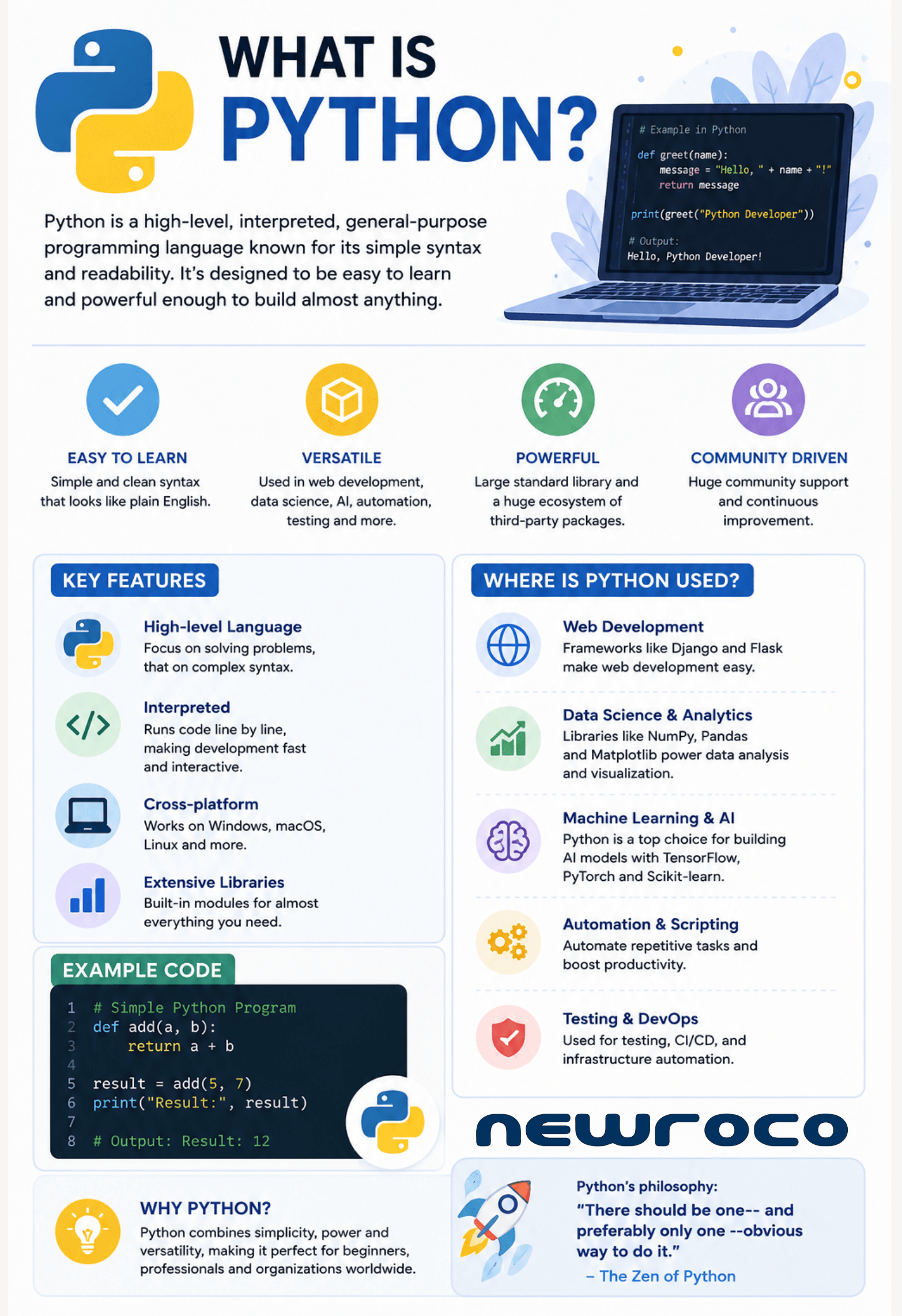
Why is Python so successful?
It is not a fluke. Web developers use Python because it presents various advantages, making it attractive to beginners and experienced users. We thought it would be useful for you to understand each advantage, one at a time.
1. Easy to read
If you compare Python to other programming languages, you will notice right away the simplicity it brings. Even beginners can understand simple commands.
2. Python comes with a generous ecosystem
Once you start using Python, you can use various libraries that can solve specific problems. Some of the most popular libraries include NumPy (computing), Pandas (data analysis), Matplotlib (data visualization), Django (web development), Flask (lightweight web app), TensorFlow (artificial intelligence), PyTorch (machine learning), and Selenium (browser automation).
The global community is generous and willing to share its experience with new libraries. Browse through them and pick the ones that match your needs.
3. It runs on various operating systems
You should know that Python runs on Windows, macOS, Linux, and cloud servers, and Linux. The flexibility makes Python optimal for research institutions, enterprise applications, and startups.
Simple example of Python that calculates the average grade of a student:
grades = [8, 10, 9, 7, 10]
average = sum(grades) / len(grades)
print(f"The average grade is {average}")
The output is: The average grade is 8.8
By analyzing this simple example, you can extrapolate and understand how Python is used for variables, lists, functions, mathematical operations, and even output formatting.
Do you want to know where Python is used in the real world?
Let’s leave the classroom behind and step into the real-world. In web development, frameworks like Django and Flask permit developers to create secure websites in a short amount of time. For instance, companies use Python to create APIs, personalized tools, dashboards, CMS (content management systems), and SaaS platforms.
In the artificial intelligence segment, Python is very popular due to TensorFlow and PyTorch. Some applications may include chatbots, image recognition, natural language processing, autonomous systems, and recommendation systems.
When it comes to data science, businesses use a huge amount of data every single day. As a result, Python can help analysts with clean datasets, pattern recognition, visualizations, and predictive models to serve specific roles.
We need to mention automation and the amazing role Python plays in limiting repetition. With the right Python scripts, users can rename thousands of files, generate different reports, scrape websites or process spreadsheets. Tasks that take mere seconds with little to no effort are possible with Python.
The Python philosophy
What is Python philosophy? The Zen of Python is easy to understand: “Simple is better than complex.” This mindset shapes the working mind of good developers. Good code is the kind that future developers can understand without issue.
Beginners should learn Python, with emphasis on practice.
Our recommendations include learning the fundamentals, then building small projects (calculator, to-do list, or a simple game), coding every day, and reading other people’s code. If you want to learn something from us, embrace mistakes as part of the learning process.
A practical learning strategy: use the 70 – 20 – 10 rule
If you want to learn Python efficiently, adopt the following framework and leave a “Thank you” in the comment section:
70% building projects
20% studying tutorials and documentation
10% theory and books
Python is more than just another programming language. Most developers consider Python the building block of web development, artificial intelligence, and automation.