
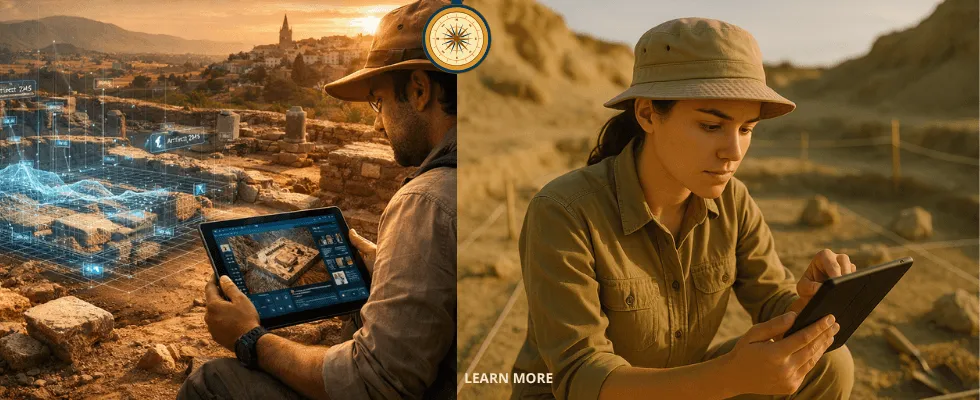
Archaeologists and personalized digital recording systems
History is complex and has different layers. The study of ancient civilizations requires time, effort, and modern tools. Archaeological excavation is a demanding set of interconnected activities. This form of research needs a special set of skills, patience, and a deeper understanding of the past.
Archaeologists work with great care at a dig site. They understand the physical relationships among layers. Once a deposit is excavated, nobody can return it to its original position. Walls can’t be unexcavated or buried again. Things get even more complicated when you factor in structure type, additional items, and human remains.
An archaeological record created in the field is very important. Why? This record becomes the lasting evidence of what was discovered on site. By doing this part well, archaeologists help researchers and historians to better understand the past. A simple discovery can undo or forge history.
In the past, this record has depended on context sheets, notebooks, drawings, printed registers, scale drawings, sketches, and photographs. All were stored separately and prone to deterioration from various factors. Such methods are still valuable and add a touch of nostalgia to the archaeology department.
There is a problem with the old way of recording archaeological findings
Today’s archaeological projects are complex and huge. They produce impressive data and interconnected information, far more than bits of paper can muster.
On the other hand, there is a more efficient way…
An archaeological digital recording system brings everything together. Data is incorporated, structured, and safely preserved! When all information is carefully stored, the archaeological project runs faster and more easily. It permits field team members to record contexts, finds, samples, photos, measurements, GPS coordinates, and interpretations directly on tablets, PCs, and smartphones.
Mobile recording for better results
Moreover, a professional and custom-made digital recording system provides a solid working environment built around the archaeological process. From the initial observation made in the dig site to extensive post-excavation analysis, reporting, and long-term archiving, the system helps users optimize their efficiency during the project evolution.
What is an archaeological digital recording system?
General solutions are not the answer. Precise and personalized digital recording systems respond precisely to archaeological needs. This is a software application that can be used to collect, organize, validate, connect, and add data for specific archaeological projects. If there are certain needs put forward by archaeologists, Newroco software development team can add digital solutions in the recording system.
Depending on the type of fieldwork and organization, the digital recording system can support more of the following features:
Context descriptions;
Trench and feature records;
Stratigraphic layers;
Finds and environmental samples/data;
Photographic evidence of finds;
Plans, drawings and coordinates;
GPS (geospatial data);
Specialist notes;
User roles and permissions;
Project-specific terminology;
Export availability for reports, analysis, and archiving.
Archaeologists won’t have to complete paper forms and later on enter the same information into a spreadsheet or database; the user will create a structured and clear digital record of the discoveries. It saves time and additional work.
There is a distinction worth mentioning
While a PDF form completed on a tablet may replace paper, it does not offer room for personalization. It is static and hard to analyze. Now, a spreadsheet can store hundreds of contexts, but it can’t manage necessary archaeological relationships across multiple users, samples, images, texts, and finds.
A custom-built digital recording system is flexible and handles complexity more easily. It understands that different archaeological records do not exist independently. A context belongs to a trench with finds, samples, photos, spatial coordinates, and more. Moreover, the real value lies in preserving the relationships between elements.
Transitioning from paperless recording to CONNECTED archaeology
We can simply state that the transition from paper to digital is easy. Tempting, but not enough to describe how valuable the change is to archaeologists. In reality, the most important change is going from disconnected records to connected data. It is impressive.
A conventional workflow may include:
1. An archaeologist completes a context sheet in the field.
2. A photo number is added in an additional register.
3. Finds have their place on another form.
4. Survey data is saved in the allocated software.
5. Paper records get verified and then added in a spreadsheet or database.
6. Problems or inconsistencies are signaled after excavation.
7. Designated members of the team look through various files to reconstruct the correct and complete record.
It takes time and a lot of effort. Every single transfer creates the optimal opportunity for delay, duplication, and transcription errors.
A digital system has a structured workflow. Easy to follow and manage, with limited chances for errors.
Context is entered once. Any related finds, photos, samples or stratigraphic relationships are linked to it. There is a field verification check before submission. Only authorized members can retrieve the data for extra security.
In our experience with archaeologists from England, through the use of a digital recording system, archaeologists have more time to apply empirical archaeological judgment. They have more time to think and create historical connections.
Let us see how a digital recording system may work in the field
For more clarity, the following situation is relevant to our argument. An archaeologist identifies a pit in a site excavation. He or she uses a tablet to open the project and create a new context record. The system assigns or validates the context number and adds a form value to the type of structure discovered.
Afterwards, the archaeologist can:
1. Select the trench or excavation location;
2. Add dimensions or distinct physical characteristics;
3. Describe composition, inclusions, and boundaries;
4. Record an initial interpretation;
5. Connect the pit to related contexts;
6. Add finds and distinct environmental samples;
7. Associate photos with the record;
8. Add coordinates or historical map references (for added value);
9. Save info locally if there is no internet connection.
Validation rules swiftly identify missing mandatory fields, invalid identifiers, or relationships that need specific confirmation. For added consistency, the system can infer lists and controlled terminology, while leaving room for archeologists to complete observations.
When an Internet connection is available, locally stored records sync up with the main project system. It is that simple and very useful. Project managers or administrators can review the data without wasting time waiting for paper sheets to be returned from the site. Fast and convenient.
Offline capability is very important in archaeology
As you probably know, archaeological sites do not make the ideal software environment. Fieldwork can take place in different parts of a country. From rural landscapes, caves, urban basements, road corridors, and areas with limited to no internet connection, archaeologists do their work and then take care of paperwork. In addition, even in places where there is signal, sometimes it is not reliable enough to maintain continuous data entry for all members of a team.
OFFLINE capability is mandatory
An offline archaeological web app permits archaeologists to record data when the Internet goes off the rails. Data is locally saved on the device and synchronized when a solid internet connection returns.
The capability is perfect in situations like:
1. Rural excavations;
2. Infrastructure projects that cover large areas;
3. Rescue archaeology;
4. Tunnel, basement, or cellar investigations;
5. International research projects;
6. Sites without Internet coverage.
Field recording should continue with or without Internet access
Quick examples of archaeological digital recording in real excavations:
Pompeii: connecting paperless forms, GIS and 3D data
2022, a team from Tulane University excavated at Insula I.14 in Pompeii. It combined paperless recording with GIS and 3D data to manage observations and spatial info from the excavation. The resulting data allowed the research team to revisit, explore, and analyze particular contexts anytime they wanted.
Key note here: digital recording is valuable when forms, spatial info, and visual data form the workflow. Archaeologists who study large urban sites need to understand where the record appeared, how it has changed, and how it relates to surrounding structures, finds, etc. Everything is connected.
Another great example is Catalhoyuk in Turkey
Amazing Neolithic settlement with so much information on this period of humanity. The project has a special challenge. Excavations took place over many years and involved international teams, various specialists, and a tone of records and archives.
Archaeologists used digital tools and tablet-based recording systems to access and interpret faster distinct information while excavating. Real-time data improved ongoing work. Tablet recording allowed for support of reflexive archeology. Furthermore, digital documentation improved certain types of workflows, in direct accordance with site complexity. Research reported capture sessions of 15 to 20 minutes for a combination of photogrammetry, laser scanning, and tablet drawing.
Key note here: not every site uses the same technology in the same manner. Archaeologists adapt to the site and use the technology’s flexibility to improve results.
We understand that archaeology does not have a universal measurement for the productivity brought forth by digital recording systems. As shown above, projects vary in size, methodology, team composition, procedures, and other requirements.
The primary benefits of digital recording systems for archeologists
1. Less duplicate data entry
2. Consistent records
3. Faster access to information
4. Better connections between finds
5. Faster identification of problems through validation forms
6. Quicker exports and reporting
7. More time for actual work on site rather than administrative work
8. Better quality assurance
9. Greater institutional memory
10. Easier team collaboration and more sustainable archives
The list goes on…
We invite you to learn more about Newroco Digital Recording System, which allows archaeologists to record data through tablets, PCs, and smartphones. It works online and offline, making it ideal for sites without or with poor internet connection. Fully customizable and supported by a great team that has experience working with archaeologists.
Our team can create custom web apps for archeologists and heritage organisations in Europe, Turkey and the United States of America. From offline digital recording and interactive maps to osteology systems, knowledge hubs and project-management platforms, our specialists tend to archaeologists' needs.
Contact us today to schedule a meeting!