
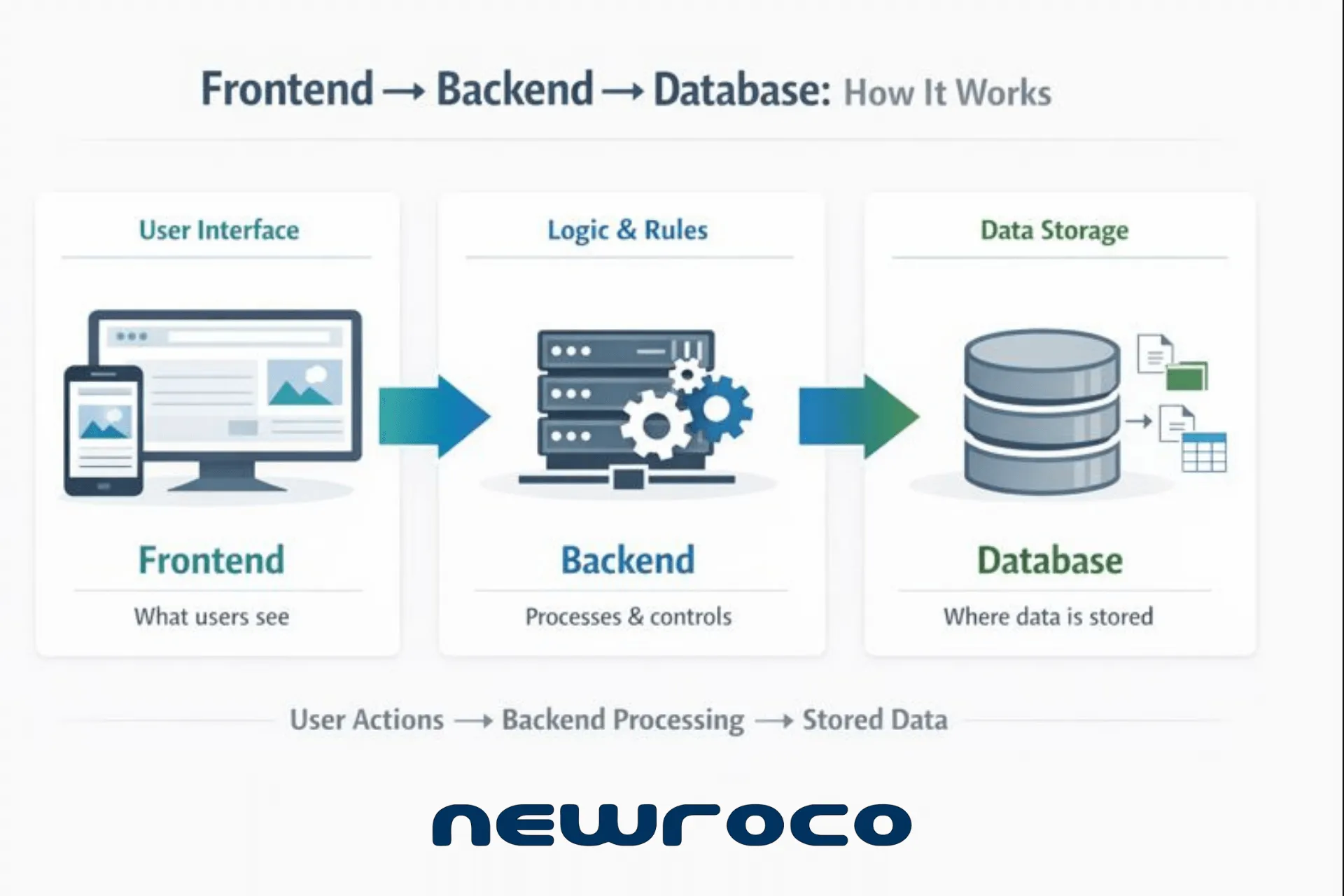
Backend in focus: infographic and useful information
Most people do not know about it, but the backend does the heavy lifting in most websites and applications. Everything seems simple when you browse a website or open a web app. You do whatever you want, and in most cases, things run smoothly.
You click, scroll, fill in forms, view videos, and read texts. Such data appears on a screen, and you access it with ease. As a user, you feel everything like magic. Yet, there is no Dumbledore behind the screen, but something else.
Every interaction is backed by a complex system called the backend.
You need to understand what a backend is. It will be illuminating and helpful when interacting with different websites and apps.
What is a backend?
A simple definition: a backend handles the logic, data, and processes of a software application. Backend happens after the user interacts with the screen. It is that simple.
Easy: the frontend is what users see and interact with, while the backend is what powers everything.
In most cases, the backend consists of a server (where it runs), an application logic (rules + operations), and a database (where the data is stored).
Users will not interact with the backend, but their actions depend on it. You cannot do one without the other.
The basics of frontend and backend
FRONTEND: layout, design, buttons, forms, menus, and displaying information to users.
BACKEND: processing requests, checking permissions, saving and retrieving data, applying rules and validations.
Short example: the user clicks “save”, the frontend sends a request, and the backend decides the next move. That is it.
Here is another example to understand the flow: what happens when the user fills a form and clicks “submit”.
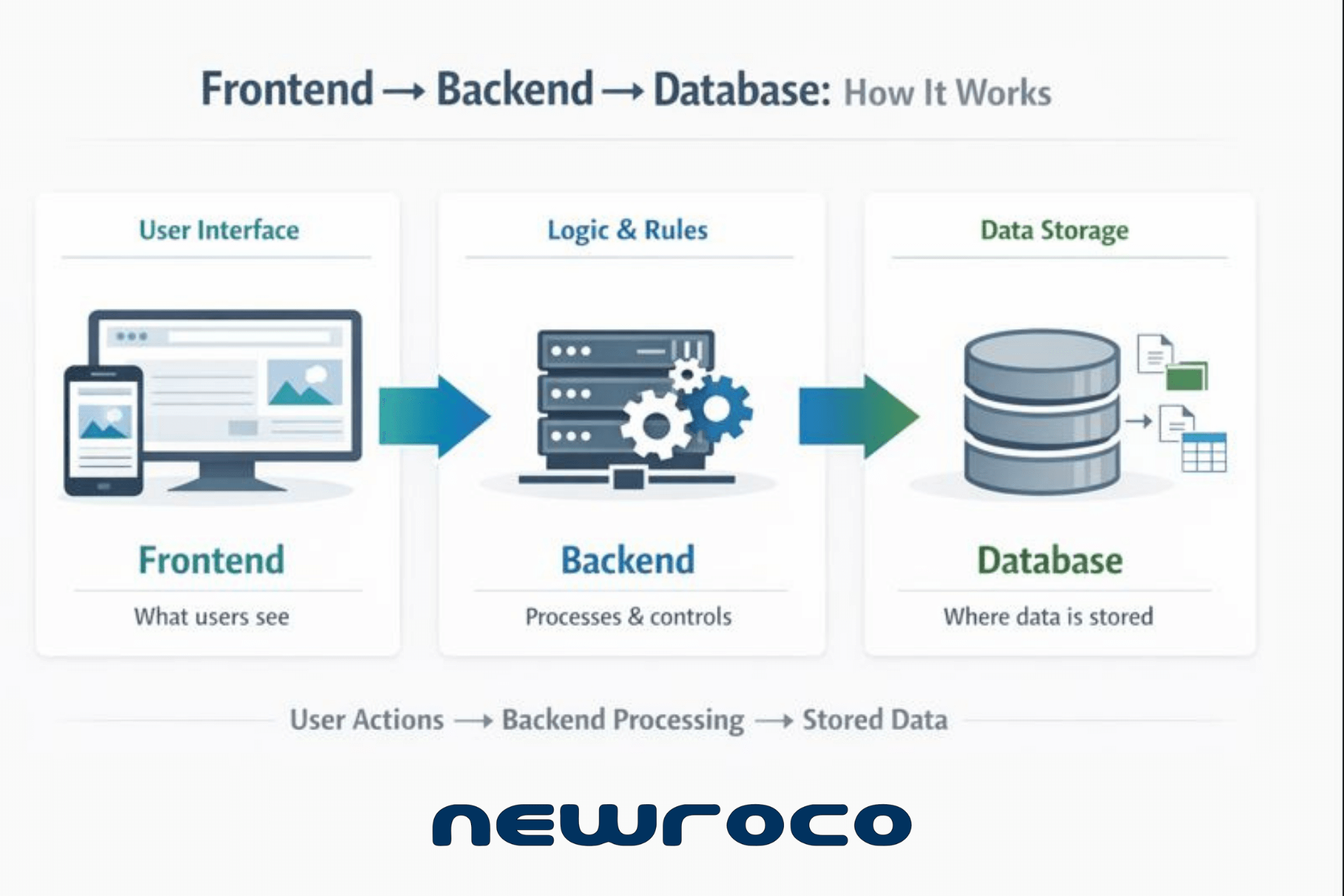
What happens behind the “scenes”?
- The frontend sends the data to the backend.
- The backend checks if the data is valid.
- It applies business rules (Is the user allowed to do this? Is the data complete?).
- The database stores the information.
- The backend sends a response back to the frontend.
- The frontend shows a confirmation message.
Everything happens in mere milliseconds. The user is oblivious to every step of the process. This is the backbone of every modern web application.
The backend and its “heart”: database
The “heart” of the backbone is the database. Why? Well, it stores user accounts, content, records, settings, and historical data. In a manner of speaking, the backend acts like an intermediary between the frontend and the database.
One important distinction: the frontend never interacts with the database directly. This infrastructure protects data integrity and limits the appearance of errors.
The backend is very important
Today, most users are interested in the way an app or website feels or looks. It is understandable, but the truth of the matter is that without a backend, data becomes insecure. A strong backend will ensure consistency on all devices, scalability as users grow, and accurate reporting and analytics.
Remember: whenever a system fails, the fault is somewhere in the backend. The visual design is fine. The backend is the solid foundation that keeps everything in check.
Short conclusion
The backend impacts the way an app or website feels, acts, and runs. From fast responses, accurate data, and solid functionality, the backend is the invisible layer that keeps everything together.
If you want to learn more about backend, frontend, and other topics, read our blog or education corner.
Simply contact us at @email!