
What is the cost of manual data recording in archaeology?
Given today’s technology, it is not surprising to say that archaeology deserves better than duplicated data entry. Young and experienced archaeologists understand this phrase, and we have a feeling they want to know how to approach the issue.
A good day on site will usually end with notebooks full of observations, sketches, context sheets, photographs, GPS coordinates, and more. Even though excavation is over, paperwork only begins. A couple of hours later, someone is transcribing the written notes into spreadsheets and databases. It is hard work. Not exactly a Sunday night out for the one responsible.
Wait, there is more.
Someone else will check the data. Another person will correct it. An IT specialist will enter the data for analysis, research, or public access. Various people handle the data on countless occasions. There is a touch of irony here. Archaeology should be about preserving history. Yet, most archaeologists keep on handling paperwork.
The problem with paperwork is time + duplication
First, manual recording is slower than other available options. It adds costs that accumulate in time. A normal workflow may include the following phases:
1. An archaeologist records context on paper.
2. Another person types the info into a database.
3. Photos are renamed one file at a time.
4. Find the numbers that are added to spreadsheets.
5. Datasets.
6. Project managers compile specific reports.
6 steps. 6 chances of inconsistency and data issues. It is risky for the actual data to remain true to this initial form.
Working with top European archaeologists taught us one important thing: inconsistent recording practices and unclear documentation patterns reduce the long-term usability and reusability of archaeological datasets. The solution? Standardized recording guidelines and digital workflows help improve data quality and collaboration across excavation team members.
We should limit human error as much as we can
Archaeologists do their best to record information without errors. Yet, manual transcription introduces errors into the workflow. In our conversations with archaeologists, some problems seem to appear out of nowhere. The most common ones include a number that is often copied incorrectly, a duplicated context ID, misunderstood handwriting, a spreadsheet formula that breaks, and many more.
Such errors collectively affect data analysis, reporting, and long-term archive quality, with implications for research development. Barcode-based recording dramatically reduced errors while saving significant time on large archaeological projects.
Now, let us do an exercise. You are part of a project that needs recording:
• 10,000 finds
• hundreds of contexts
• thousands of photographs
• multiple excavation teams
A small percentage of transcription errors quickly becomes hundreds of corrections. Delays rarely happen in the trench. They happen afterwards.
Many excavations finish fieldwork only to enter another lengthy phase:
• typing notes;
• checking spreadsheets;
• validating IDs;
• organising photographs;
• preparing reports.
Weeks of administrative work often follow weeks of excavation. The cycle doesn’t produce new archaeological knowledge. You convert data from one format into another and repeat. It can be tiresome.
Digital recording changes this equation significantly.
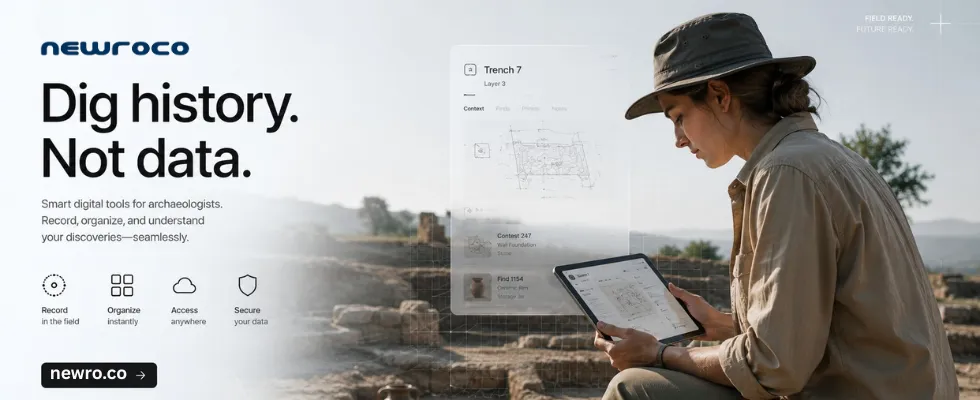
Instead of entering the same information twice, archaeologists record it once. The data is immediately available to the rest of the team. The researcher gets the data instantly. He or she already works on various theories on data sets, coming live from the dig site. Time gained!
• No retyping.
• No duplicated effort.
• No waiting until the end of the season.
Inconsistent datasets create long-term problems
An excavation does not end when the trench is backfilled. The real legacy of the years of work is the data. Future researchers depend on accurate and well-structured information.
Unfortunately, inconsistent recording standards often make archaeological datasets difficult to reuse across projects or even between excavation seasons. Top researchers have emphasized the importance of clear documentation, consistent naming conventions, and structured digital workflows to improve archaeological data quality and support future reuse.
Good archaeology deserves good data.
Digital recording is not about replacing archaeologists. On the contrary! It is about removing unnecessary administration and helping archaeologists perform better.
Some people assume digital recording exists simply to replace paper. Not the case. The main objective is to remove friction. For example, our archaeological software does not change archaeological thinking but supports it fully.
We believe field teams should spend more time observing, interpreting, and documenting archaeology, not copying information between notebooks, spreadsheets, and databases.
That is where custom software makes all the difference in the world. Unlike generic forms or off-the-shelf databases, a purpose-built archaeological recording system reflects the way archaeologists actually perform their tasks on and off dig sites.
1. It understands contexts.
2. Finds.
3. Stratigraphy.
4. Photographs.
5. Permissions.
6. Offline environments.
7. Changing recording requirements.
Why Newroco builds software for archaeology in Europe
For more than 20 years, we've collaborated with archaeological organizations, including Oxford Archaeology, developing custom digital solutions that solve real fieldwork challenges.
Our experience includes:
- Digital Recording Systems;
- Archaeological CMS platforms;
- GIS and mapping solutions;
- Time recording solutions;
- Osteology solutions;
- Fieldwork applications;
- Recording systems;
- Project management tools;
- Archaeological data platforms.
These solutions have a solid archaeological basis.
They were designed together with archaeologists who understand the realities of excavation sites, limited connectivity, changing workflows, and the importance of accurate data.
Whether you are recording a single trench or managing a multi-year excavation, we believe software should adapt to archaeology, and not the other way around.
The future of archaeology is digital and human. There is no doubt about it, excavation will always require skilled archaeologists. Modern technology cannot replace experience, interpretation, or expertise. Not even AI.
The primary benefits of adapting archaeological technology:
1. It can remove repetitive work.
2. It can reduce transcription errors.
3. It can standardise recording.
4. It can improve collaboration.
Probably the most important aspect is that it gives archaeologists more time to focus on archaeology.
Are you looking for custom archaeology software?
Every excavation has its own workflow, recording standards, and reporting requirements.
That is why off-the-shelf software often falls short.
We design custom web applications for archaeology, built around your team's way of working, not the other way around. Please explore our portfolio and see how we helped other archaeological institutions perform better and create amazing workflows.
Why trust Newroco?
- 20+ years building software
- Collaboration with Oxford Archaeology
- Digital Recording Systems
- GIS & Mapping Solutions
- Archaeological CMS platforms
- Offline-first web applications
Thousands of archaeological records managed
Whether you need a Digital Recording System, GIS integration, an archaeological CMS, offline-capable Progressive Web Apps, or a completely bespoke platform, we will build software that improves data quality, streamlines fieldwork, and grows with your projects.
Talk to our archaeology software team about how we can help!